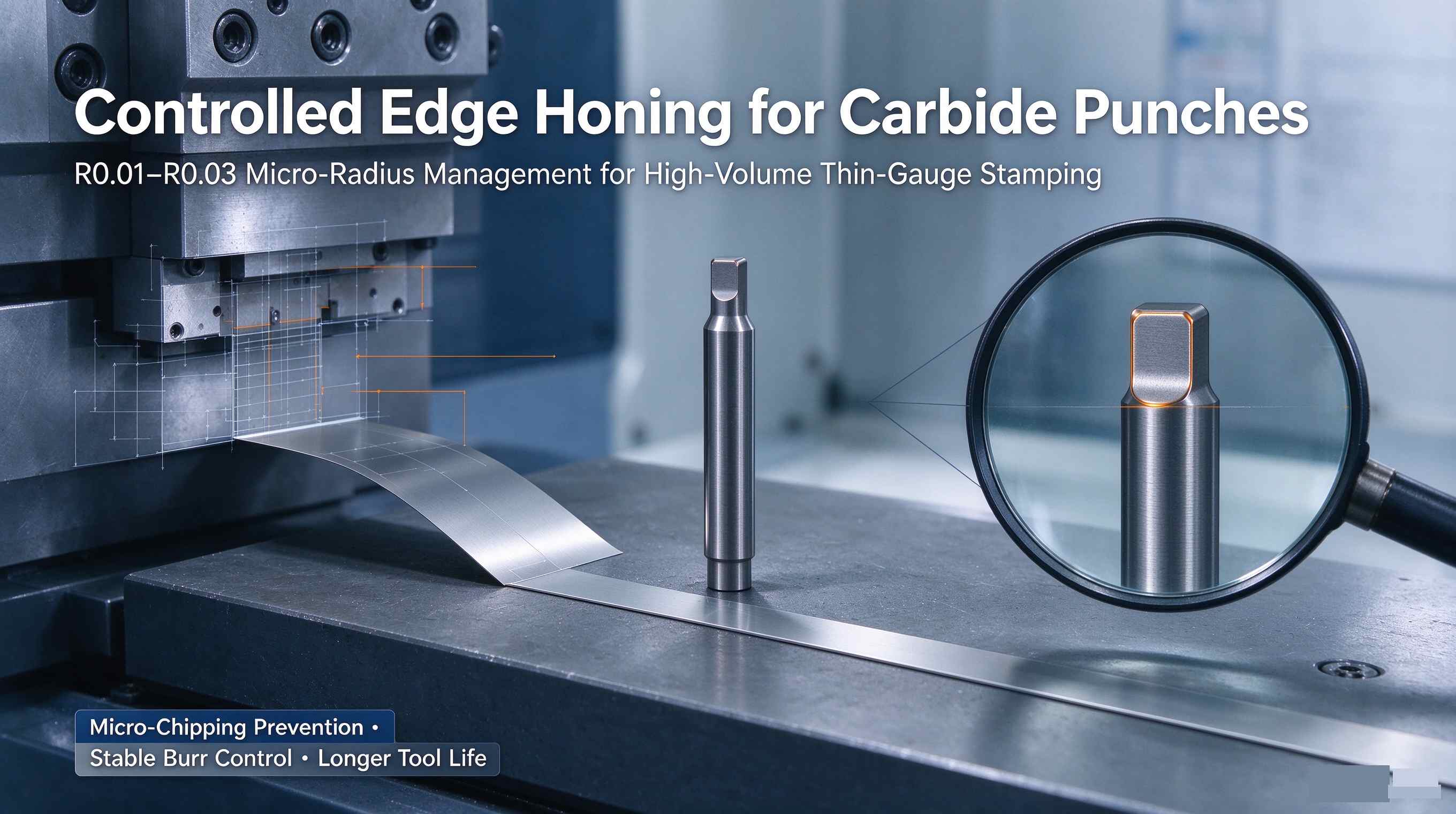
In high-precision progressive-die stamping, most carbide punch failures are not caused by poor material selection or wrong clearance settings. They stem from one commonly overlooked detail: an excessively sharp cutting edge.
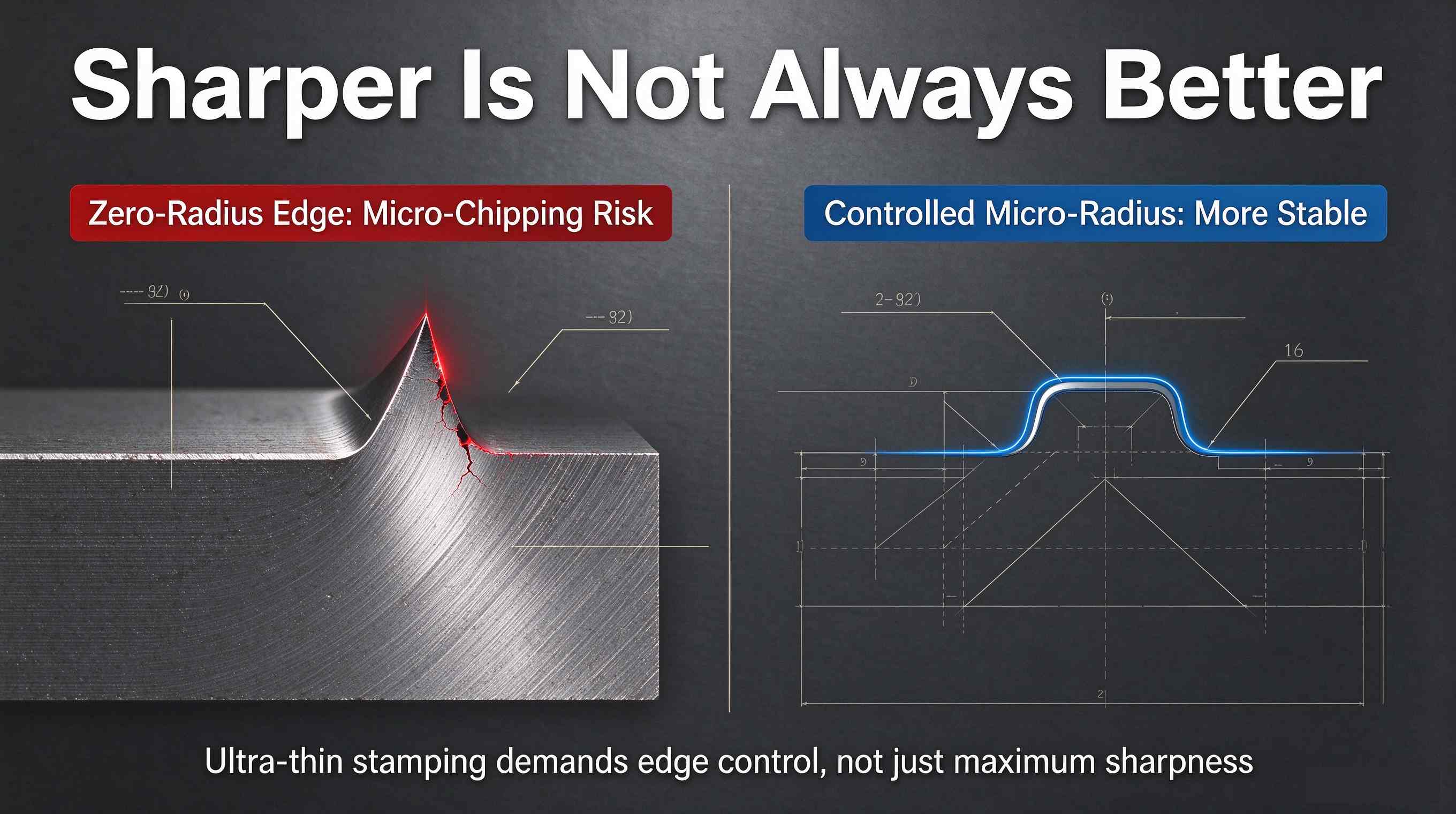
Many tooling engineers and shops still pursue a “perfectly sharp” edge as best practice. However, zero-radius razor-sharp edges carry hidden risks in mass production: micro-chipping, premature flank wear, and inconsistent part quality. That is why controlled micro-edge honing to R0.01-R0.03 has become a preferred critical process for carbide punches used in automotive terminals, electronic connectors and medical precision components.
After wire-EDM and ultra-precision optical grinding, carbide punch edges retain micro-defects invisible to the naked eye: fine grinding cracks, EDM recast layers, and sharp stress-concentration points. Under repeated cyclic impact, friction and shear loads during stamping, these tiny defects propagate quickly, leading to edge chipping, wear, and even local edge collapse.
The real-world consequences are clear: unstable burr height on stamped parts, unplanned production downtime, shorter punch service life, and higher costs from frequent tool replacement and machine re-adjustment.
Controlled edge honing is a standardized micro-machining process. It removes defective surface material and creates a uniform, smooth micro-radius along the entire cutting profile.
This is very different from ad-hoc manual polishing, which often results in uneven edge removal and dimensional drift. Our precision honing locks the edge radius tightly within R0.01-R0.03 — the optimal process window for 0.05–0.3 mm ultra-thin sheet stamping.
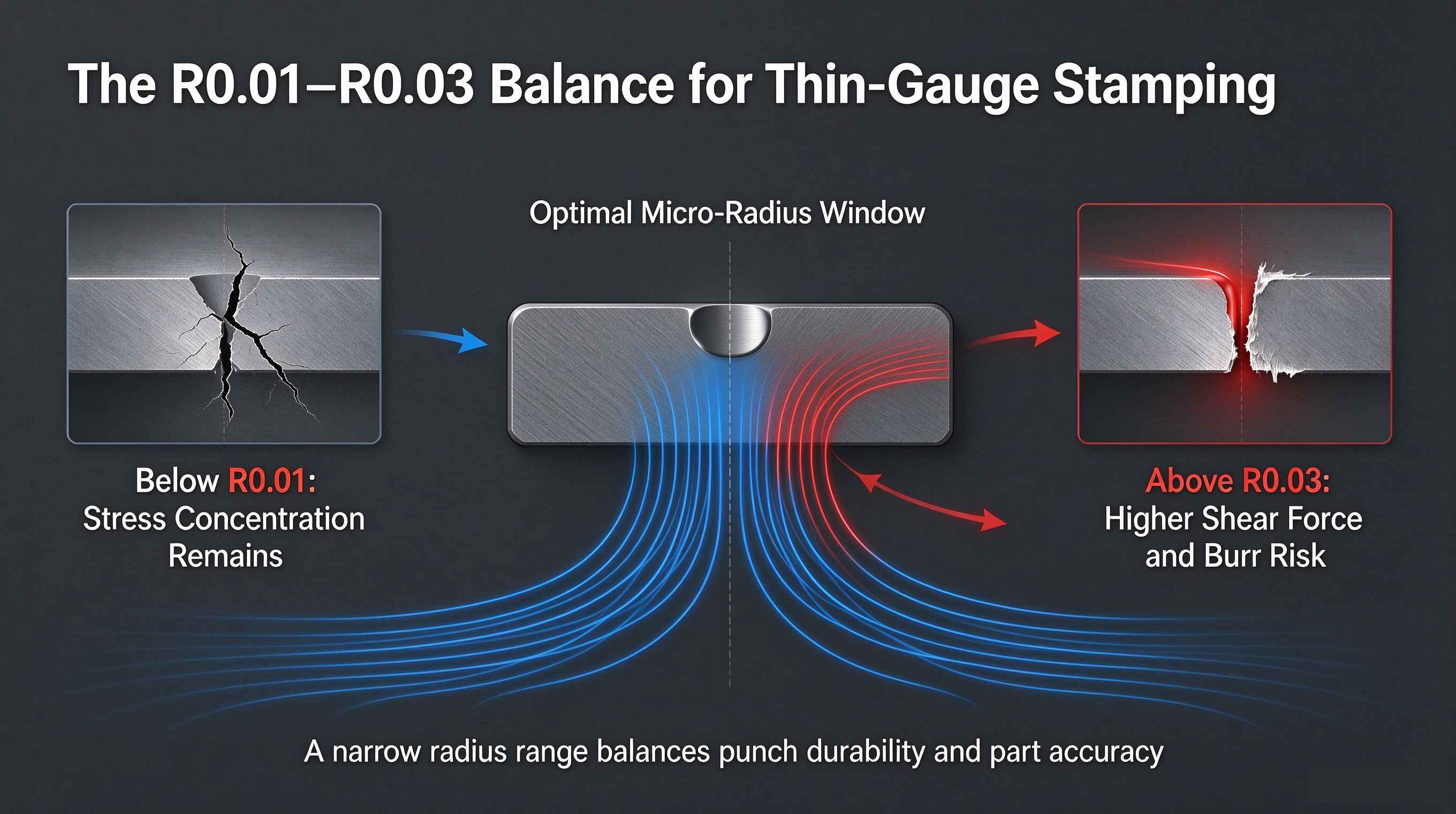
This narrow radius range strikes a practical balance between two essential goals: tool durability and stamping accuracy.
· Radius below R0.01: Stress concentrations and micro-defects cannot be fully removed, providing limited improvement in punch fatigue resistance.
· Radius above R0.03: Thickened cutting edge increases stamping shear force, worsens material tearing, and produces excessive burrs and dimensional distortion. Flatness and tight tolerances of precision parts will be compromised.
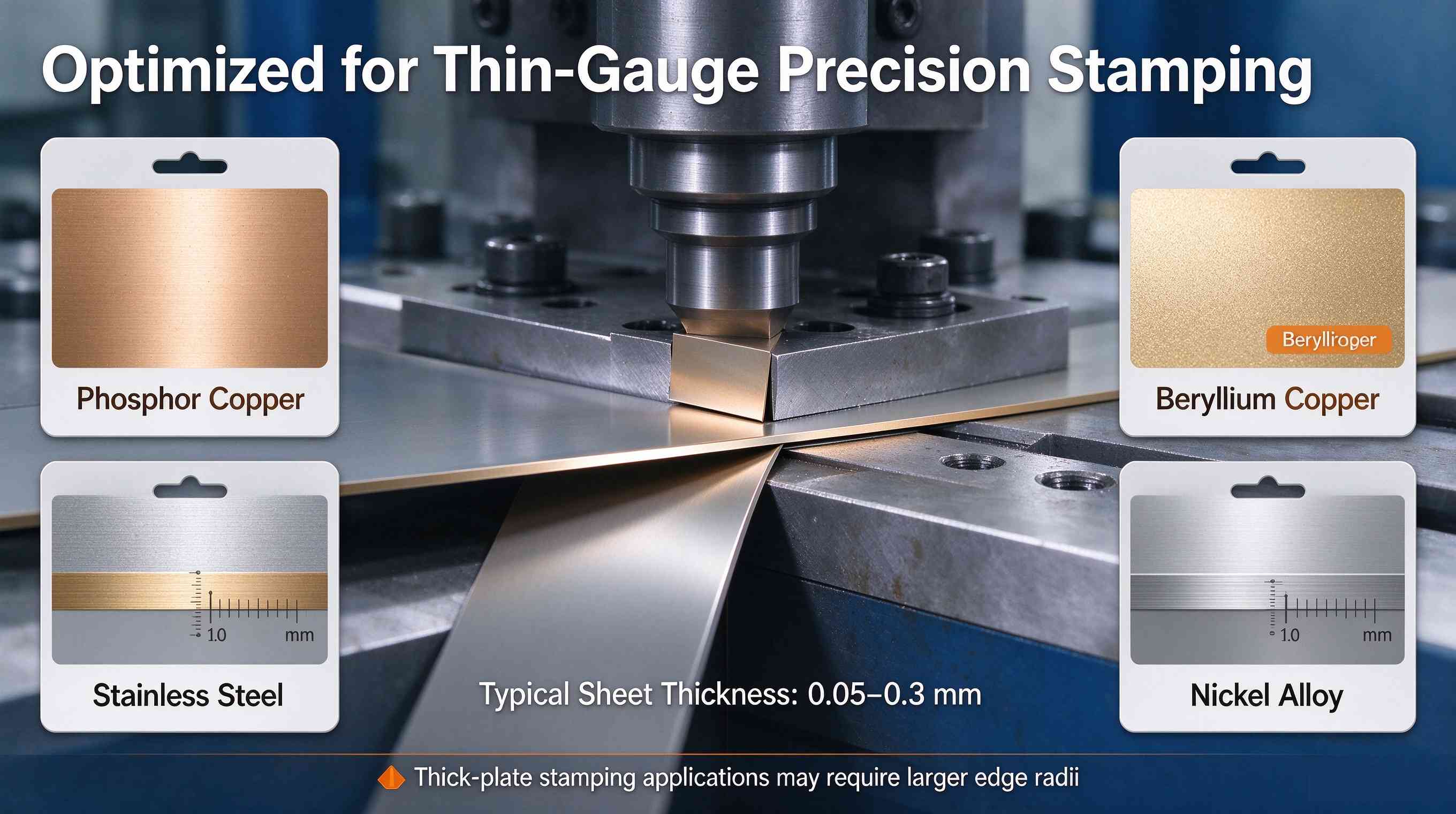
Important application note: The R0.01-R0.03 honing specification is optimized for thin sheets 0.05-0.3 mm. For thick-plate stamping applications, typical edge-honing radii range from R0.05 to R0.2. Please do not apply this parameter blindly across all stamping jobs.
The benefits of R0.01-R0.03 controlled honing shine in high-volume precision production. Working with phosphor copper, beryllium copper, high-strength stainless steel and nickel-alloy thin sheets, the micro-rounded edge dissipates instantaneous stamping impact, prevents brittle fracture of carbide edges, and maintains repeatable cutting performance over long production runs.
Field-proven production data shows that punches with standardized controlled edge honing deliver 2-3× longer service life versus conventionally sharp-edged punches. At the same time, part burr variation and tool maintenance frequency can be reduced by more than 60%.
Beyond extended tool life, controlled edge honing improves overall die-system stability. A smooth, consistent edge profile lowers friction and material pickup during stamping, effectively reducing galling and material-pulling defects.
For complex shaped punches, step punches, and micro-punches smaller than 1 mm in diameter, consistent edge rounding on corners and weak-profile features eliminates local stress hot-spots and significantly reduces the risk of partial edge breakage in operation.
It is worth clarifying: precision edge honing is not cosmetic finishing. It is a core process that defines punch reliability. After honing, we perform full-profile optical inspection to verify micro-radius uniformity over the complete cutting edge. This eliminates hidden blind-spot defects and ensures reliable batch-to-batch consistency for custom precision punches.
Practical tip: Edge-honing quality strongly influences subsequent coating adhesion. Out-of-tolerance edge radius will directly worsen part burrs, making radius control and inspection essential.
In today’s competitive precision-stamping market, hitting basic dimensional requirements is only the baseline. Controlled edge treatment is key to stable high-volume output and lower total operating costs.
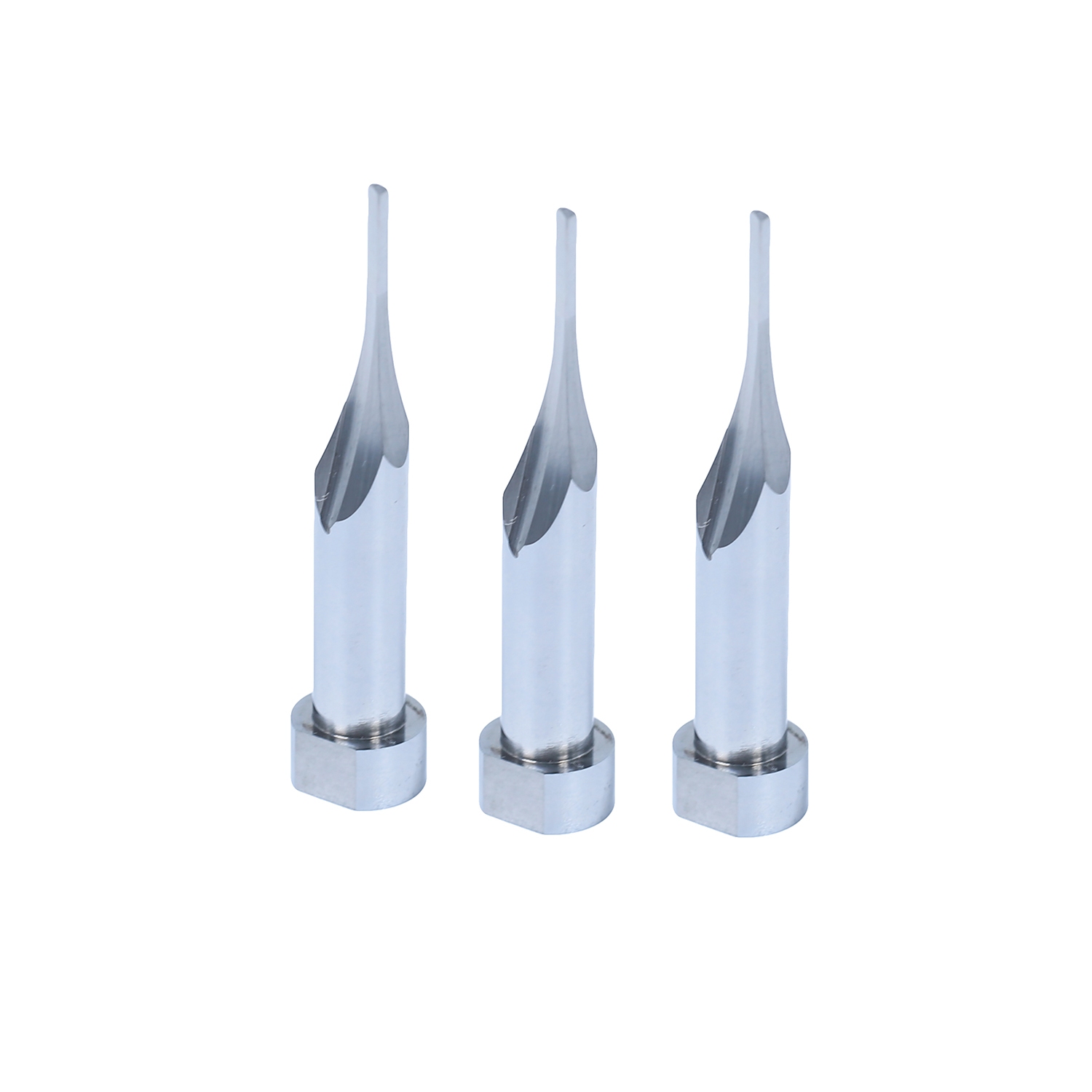
If you are facing recurring punch chipping, erratic burr performance or short tool life in your high-volume stamping lines, standardized R0.01-R0.03 controlled edge honing offers a highly cost-effective tooling upgrade option.
Have you run into edge-related tooling issues in your stamping shop? Feel free to share your experience in the comments.


© 2026 © HONGYU MOULD LIMITED. All Rights Reserved.
 IPv6 network supported