How to Achieve ±0.002mm Precision for Special—Shaped Punches: Charmilles Wire EDM + Optical Profile Grinding
Nov 19, 2026
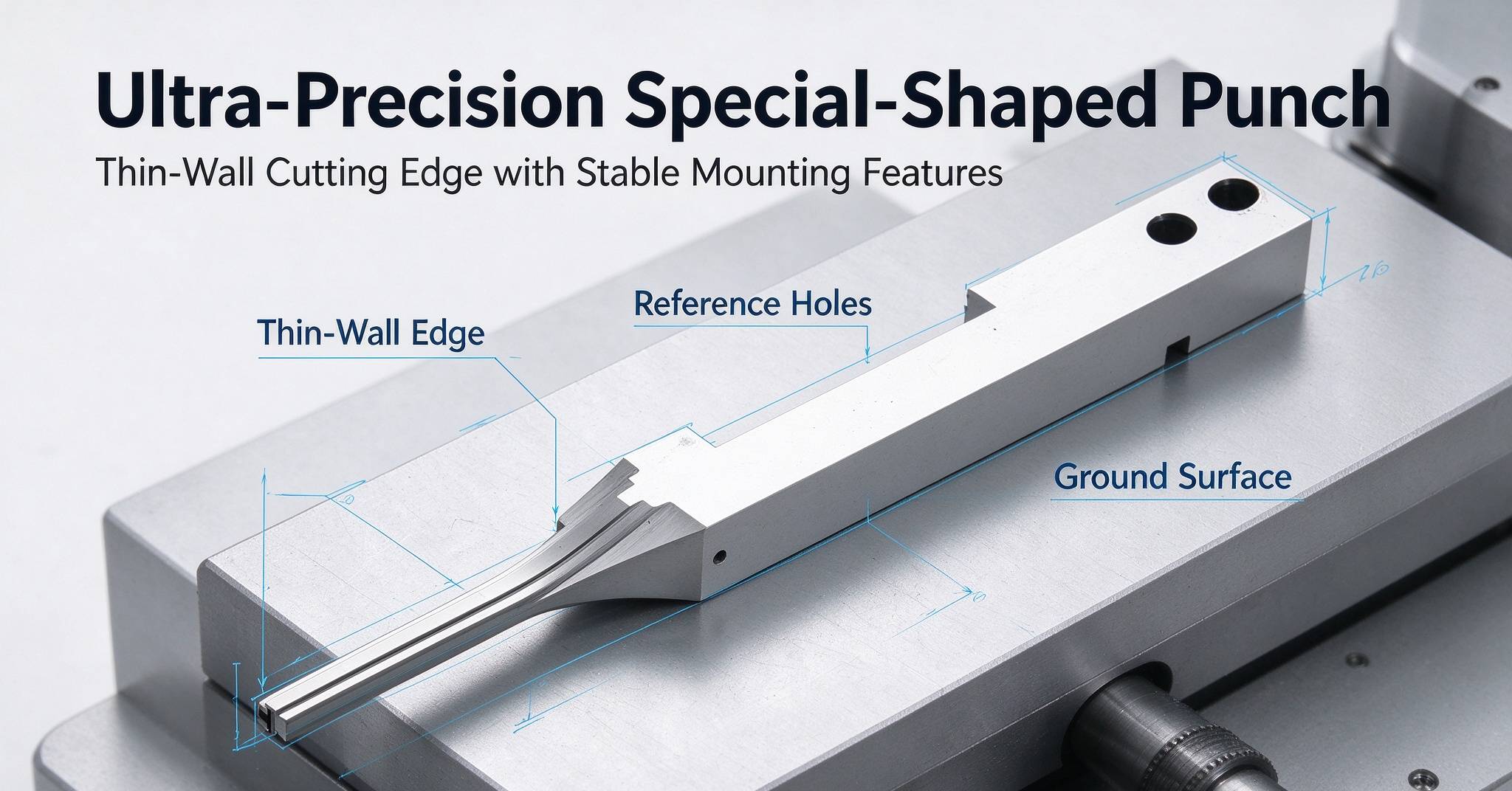
In high-end stamping industries including semiconductor lead frames, precision electronic connectors, and new energy terminal manufacturing, standard punches with ±0.005mm tolerance can no longer meet mass production demands. Ultra-precision special-shaped punches requiring ±0.002mm repeatable tolerance, flawless sharp corners, and stable thin-wall structure have become the core tooling to eliminate burrs, ensure consistent shear surfaces, and reduce stamping downtime. The ultra-high precision is not achieved by single machining, but by the perfect combination of Charmilles slow-speed wire EDM and professional optical profile grinding.
Charmilles slow-speed wire EDM serves as the primary contour forming process for special-shaped punches, laying a high-precision foundation for complex profiles and thin-wall structures. Conventional fast wire EDM easily causes thermal deformation and micro-edge chipping, failing ultra-precision scenarios. In contrast, Charmilles wire EDM adopts multi-cutting technology consisting of one rough cut and multiple skim passes, reserving a precise 0.03–0.05mm finishing allowance while removing most material stress. By optimizing pulse width and low-current discharge parameters, it minimizes thermal impact on carbide and high-speed steel materials, effectively avoiding thin-wall warpage and corner distortion. This process stably controls preliminary contour tolerance within ±0.003mm and delivers a smooth surface finish below Ra 0.2μm, eliminating most macroscopic tool marks.
Despite precise wire EDM pre-processing, microscopic tool deflection and residual stress still leave tiny errors on sharp corners and ultra-thin walls, which are fatal for micron-level precision stamping. This is where optical profile grinding plays its irreplaceable role as the final precision calibration process. Different from ordinary surface grinding, optical grinding realizes full-profile visual alignment and real-time error correction through high-precision optical projection systems. It targets the weakest parts of special-shaped punches—sharp corners and thin-walled structures—adopting micron-level intermittent micro-feed grinding instead of continuous feeding. This low-stress processing mode completely avoids secondary deformation and edge chipping caused by grinding impact.
The core advantage of optical grinding is its extreme local precision control. It accurately polishes sharp corners to restore complete verticality without rounded transition errors and calibrates thin-wall flatness and perpendicularity to lock the final tolerance within ±0.002mm. Meanwhile, the process removes residual EDM metamorphic layers, improving punch surface smoothness and fatigue resistance, which directly extends tool service life in high-frequency continuous stamping. For thin-wall punches with wall thickness below 0.1mm and tiny special-shaped corner structures, this dual-process collaboration solves the long-standing industry pain point of unstable dimensional accuracy after mass production.
The combination of Charmilles slow wire cutting and optical profile grinding distinguishes ordinary die punches from ultra-precision industrial-grade tooling. It not only achieves strict ±0.002mm dimensional tolerance but also ensures long-term geometric stability of sharp corners and thin walls during millions of stamping strokes. For overseas manufacturers pursuing high yield rate and low maintenance cost, this mature precision processing solution effectively reduces punch replacement frequency, lowers die debugging costs, and improves overall production efficiency.
Our factory specializes in custom ultra-precision special-shaped stamping punches, fully applying Charmilles wire EDM and optical grinding technology to support customized tolerance requirements from ±0.001mm to ±0.002mm. We provide stable, high-life precision tooling solutions for global precision stamping and mold manufacturing clients.


 IPv6 network supported