Impact of Surface Treatments—Nitriding, Titanium Coating, and Sandblasting—on Stamping Die Life
Jun 12, 2026
In daily production of metal stamping dies, issues such as die wear, galling, chipping, and rusting are key factors affecting production efficiency. As the hardness and wear resistance of die base materials are limited, surface treatment processes are the most efficient and commonly used methods to increase the number of stamping operations and extend die life. Among them, nitriding, titanium coating, and sandblasting are the most widely applied techniques. The principles, characteristics, and effects of these three methods on stamping die life differ significantly, and each is suited to specific production scenarios.
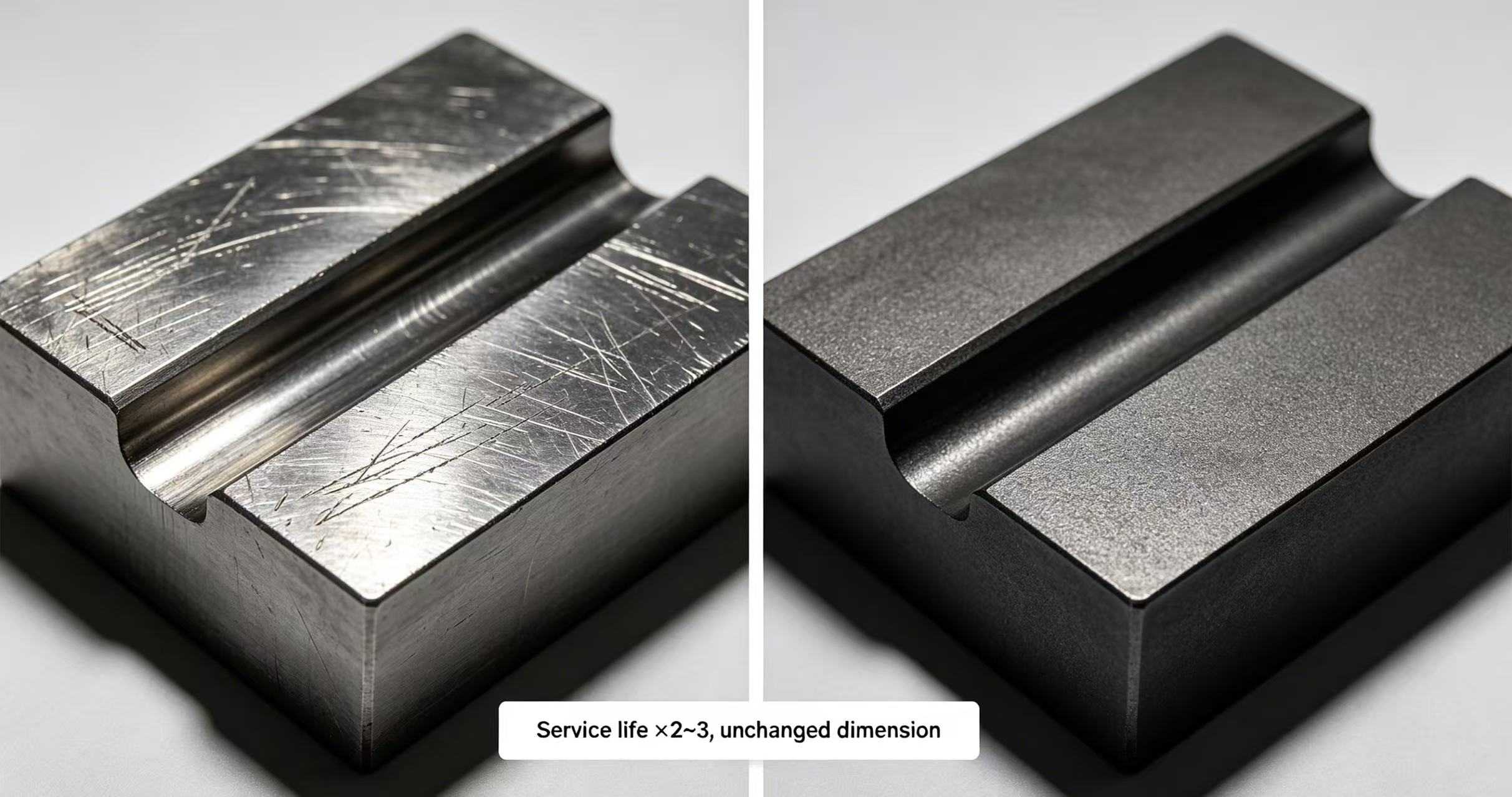
Nitriding is the most fundamental and cost-effective long-term surface treatment in the die industry, and is the preferred choice for standard stamping dies. Through high-temperature diffusion, a dense nitrided hardening layer is formed on the die surface. This process does not change the overall dimensions of the die and does not affect assembly accuracy. Nitriding can significantly enhance surface hardness, improving wear resistance, galling resistance, and minor corrosion resistance, effectively preventing sheet galling and moderate wear during stamping. Dies treated with nitriding can achieve two to three times longer service life, making this method suitable for stainless steel, general cold-rolled steel, and other conventional stamping applications. However, its limitations are also apparent: the hardening layer is relatively thin, and impact and high-temperature resistance are moderate, making it unsuitable for high-speed stamping or stamping of high-hardness materials.
Titanium coating is a high-end reinforcement process and is the most effective method for significantly increasing die life. Titanium coating involves depositing an ultra-thin layer of high-hardness, highly lubricious titanium alloy on the die surface. The coating far exceeds the nitrided layer in hardness and offers exceptional wear resistance, high-temperature resistance, and a low coefficient of friction. During stamping, the coating can greatly reduce friction between the die and the sheet, completely eliminating galling, carbon buildup, and sticking issues. Even under high-speed, high-frequency operations, the die surface remains smooth. A high-quality titanium-coated die can last five to ten times longer, making it ideal for high-speed continuous stamping, stainless steel, and high-strength steel in heavy-duty applications. The only downside is the higher cost and the fact that the coating cannot be locally repaired once damaged.
Unlike the previous two reinforcement methods, sandblasting is a physical surface treatment whose main function is not to enhance hardness, but to optimize surface condition. Sandblasting uses high-pressure abrasive particles to impact the die surface, refining the surface texture, removing oxide scale and machining marks, and eliminating stress concentrations. This process improves demolding performance, reduces burrs on stamped products, and slightly mitigates galling issues. However, it does not increase die hardness or wear resistance, offering only a minimal improvement to die life. Sandblasting is mainly used for pre-treatment, improving appearance, and relieving surface stresses.
In summary, each of these three methods has its own advantages and is fit for particular applications. For low-cost, standard mass production applications, nitriding is the preferred choice. For high-speed, high-hardness sheet metal and long-life production, titanium coating is recommended. For pre-treatment and surface finish optimization, sandblasting should be selected. Effectively combining these surface treatment techniques can significantly extend die life, reduce maintenance frequency, lower production costs, and ensure stable stamping operations. Such refined die maintenance and appropriate cost control are the keys to increasing efficiency and reducing expenses in stamping production.


 IPv6 network supported