Why "Wire EDM Profile Deviation ±0.002 mm" Is a Systems Engineering Challenge — Not Just a Machine Spec
Sep 04, 2026
Meta description: A ±0.002 mm profile deviation on a wire EDM drawing looks like a single number, but it actually demands five tightly controlled links — wire, electricity, water, path, and environment. Here is why this specification is really a systems engineering problem, and what to look for in a precision wire EDM partner.
On any precision mold or stamping die drawing, you will often find a note such as:
"Maximum allowable profile deviation: ±0.002 mm."
For someone unfamiliar with wire EDM, that line can look like just another tolerance. But for an experienced slow wire EDM (WEDM) operator, those two microns are a wake-up call. They mean that from machine selection and electrical parameters to wire condition, water quality, cutting path, and even workshop temperature, every link in the chain must reserve room for those two microns.
Get any one of those links wrong, and the part will fail inspection.
This article breaks down why ±0.002 mm is fundamentally a systems engineering challenge — and what a B2B buyer should expect from a serious precision EDM partner.
What ±0.002 mm Actually Means
To put this number in perspective:
l 2 microns = 0.002 mm
l A human hair is roughly 70 microns in diameter
l That means the allowable deviation is less than 1/35 of a hair's thickness
No single component of a wire EDM machine, on its own, can hold a 2-micron profile. The number is only achieved when wire, electrical energy, dielectric water, tool path, and ambient conditions are all dialed in together. That is the essence of systems engineering: an end result that emerges from the whole, not from the sum of its parts.
The 5 Critical Links in a Precision Wire EDM Process
1. Electrode Wire Selection and Tension Control
The "cutting tool" in wire EDM is not a solid end mill — it is a brass or molybdenum electrode wire as thin as 0.10–0.30 mm. That wire already carries its own diameter tolerance.
Why it matters:
l If a Ø0.25 mm brass wire is actually 0.002 mm oversized, the discharge gap widens and the finished profile shifts outward.
l If wire tension fluctuates, the wire vibrates during cutting, and that vibration transfers directly to the workpiece surface as waves or dimensional scatter.
What good looks like:
l Precision-grade electrode wire with tightly controlled diameter
l Continuous wear monitoring with in-process compensation
l An automatic tension control system that holds tension fluctuation within a narrow band even at high wire speeds
This is one area where entry-level and high-end machines diverge sharply. Closed-loop tension is not optional for ±0.002 mm work.
2. Precise Matching of Discharge Parameters
Wire EDM removes material through pulsed electrical discharge. Each pulse carves a tiny crater, and the depth of that crater is set by the energy of the pulse.
The core trade-off:
Higher discharge energy
Lower discharge energy
Faster cutting
Slower cutting
Rougher surface
Smoother surface
Larger profile deviation
Tighter profile deviation
For ±0.002 mm profile accuracy, the finishing pass must run on very low energy:
l Narrower pulse width
l Lower peak current
l Often a dedicated "non-electrolytic power supply" or "ultra-fine finish circuit" for the final skim cut
The downside is well known: cutting time can 3–4x compared to a roughing cut. That is one reason micro-precision EDM work is never quoted cheaply — the machine time is real.
3. The Hidden Impact of Water Quality and Filtration
This is the most overlooked link in the chain, and one of the most punishing when it is ignored.
Wire EDM uses deionized water as the dielectric. The resistivity of that water directly controls the stability of the discharge gap:
l Resistivity too low → discharge energy disperses → gap widens → profile runs oversized
l Resistivity too high → discharge becomes unstable → wire breakage and abnormal sparking
For ±0.002 mm, the typical control band is:
l Resistivity held stably above 1 × 10⁵ Ω·cm
l Resin tank replacement on a fixed schedule
l High-efficiency filtration keeping the machining zone clean
The condition of the resin tank and the micron rating of the filter elements show up, line by line, in the final profile accuracy. A shop that treats its water system as an afterthought cannot hold 2 microns.
4. Process Intelligence in Cutting Path and Stock Allocation
Two experienced process engineers can be handed the same drawing, program two different paths, and get two very different results. Path planning is where experience shows up in the part.
The standard multi-pass strategy for ±0.002 mm:
1. Rough cut — remove the bulk of the stock and release internal stress
2. Semi-finish cut — correct any deformation caused by stress release
3. Finish cut (skim cut) — reach the final size and surface quality
Each pass has a precisely calculated offset, derived from:
l Material thickness
l Geometric complexity
l The behavior of the specific machine
If the offset is too generous, the finish pass cannot clean up the prior pass's marks. If it is too tight, the final pass may not reach the reference surface at all. The "feel" for these numbers is built from years of trial cuts and accumulated data — not from a parameter sheet.
5. The Influence of Temperature and Environment
The last, and most underestimated, variable is the ambient environment.
l A 2-micron error is perfectly acceptable in a 20 °C ± 0.5 °C constant-temperature workshop
l In an uncontrolled environment, even ±2 °C of fluctuation can consume most of the tolerance through thermal expansion and contraction of the workpiece
That is why precision wire EDM workshops invest in:
l Constant-temperature air conditioning
l Long equalization times before machining
l Coolant and air-flow management around the work area
A supplier that machines precision parts in a general factory floor — even with a great machine — will struggle to hold 2 microns consistently.
Why This Matters for Your Project
If your drawing calls for ±0.002 mm profile deviation, you are not buying a machining service. You are buying access to a controlled system:
l A machine with closed-loop wire tension
l A generator with micro-finish circuits
l A water system with stable resistivity
l A process engineer who knows how to plan the path
l A workshop that holds temperature steady year-round
Any weak link, and the chain breaks. That is why some jobs are simply not something every factory can take, regardless of what their marketing says.
Looking for a Precision Wire EDM Partner?
At Dongguan HongYu Mould Co., Ltd., ±0.002 mm profile deviation is a daily production target — not a special request. Our capacity is built around:
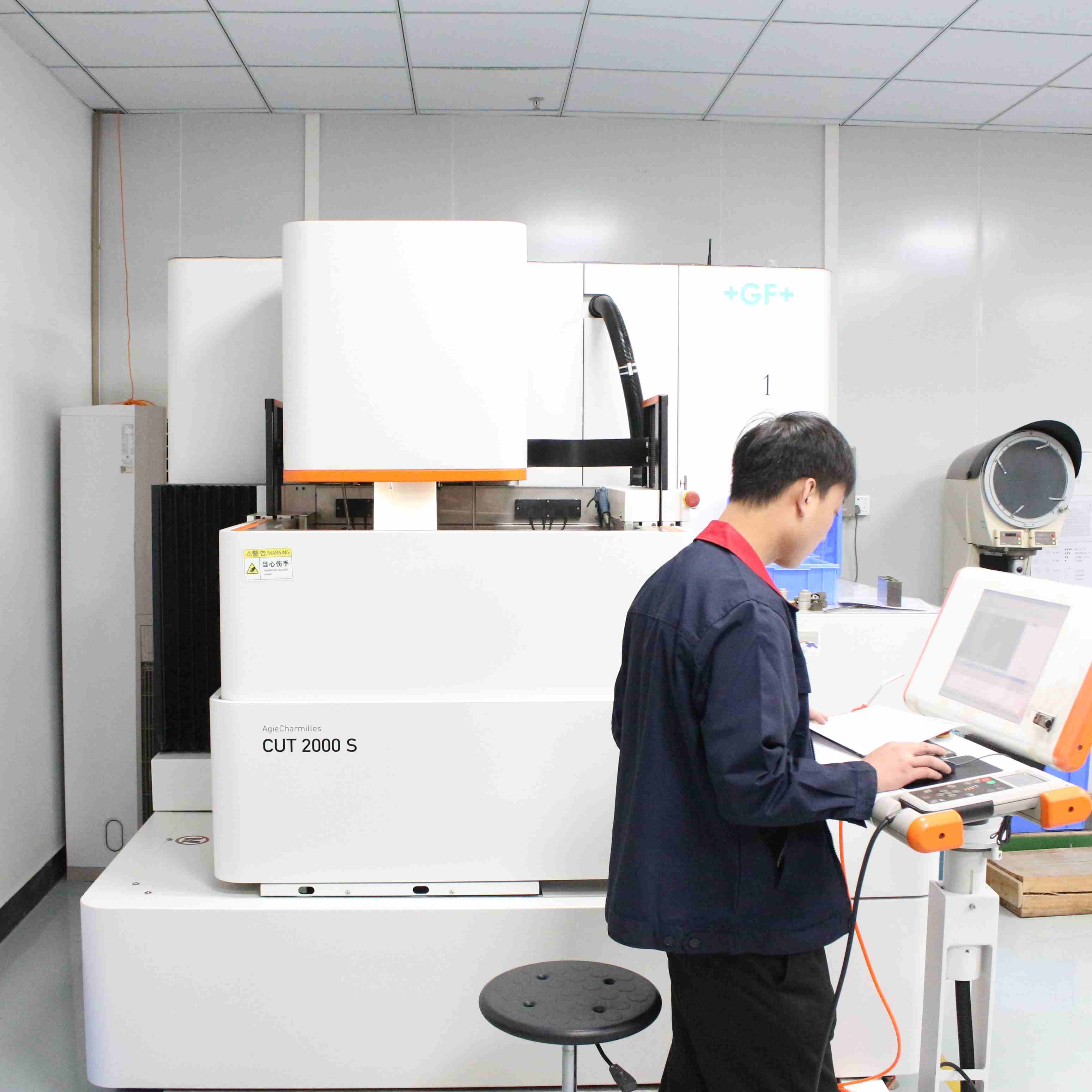
l AgieCharmilles, Sodick, and Waida high-end slow wire EDM platforms
l A constant-temperature workshop with controlled humidity
l In-house deionized water systems with continuous resistivity monitoring
l A multi-pass cutting database refined over 19 years of export work
l 19+ years of dedicated experience serving European and Japanese B2B customers in automotive, electronics, IC packaging, and industrial machinery
We work directly with mold makers, stamping die builders, and precision parts manufacturers who need tolerances they can actually rely on — and who need a partner that can explain, in plain language, where every micron of their tolerance is being spent.
Send us your drawing, and we will tell you honestly whether it is buildable, and how.
👉 sales01@dghongyumold.com for a feasibility review within one business day.


 IPv6 network supported